
Genetesis
cardioflux.genetesis.com
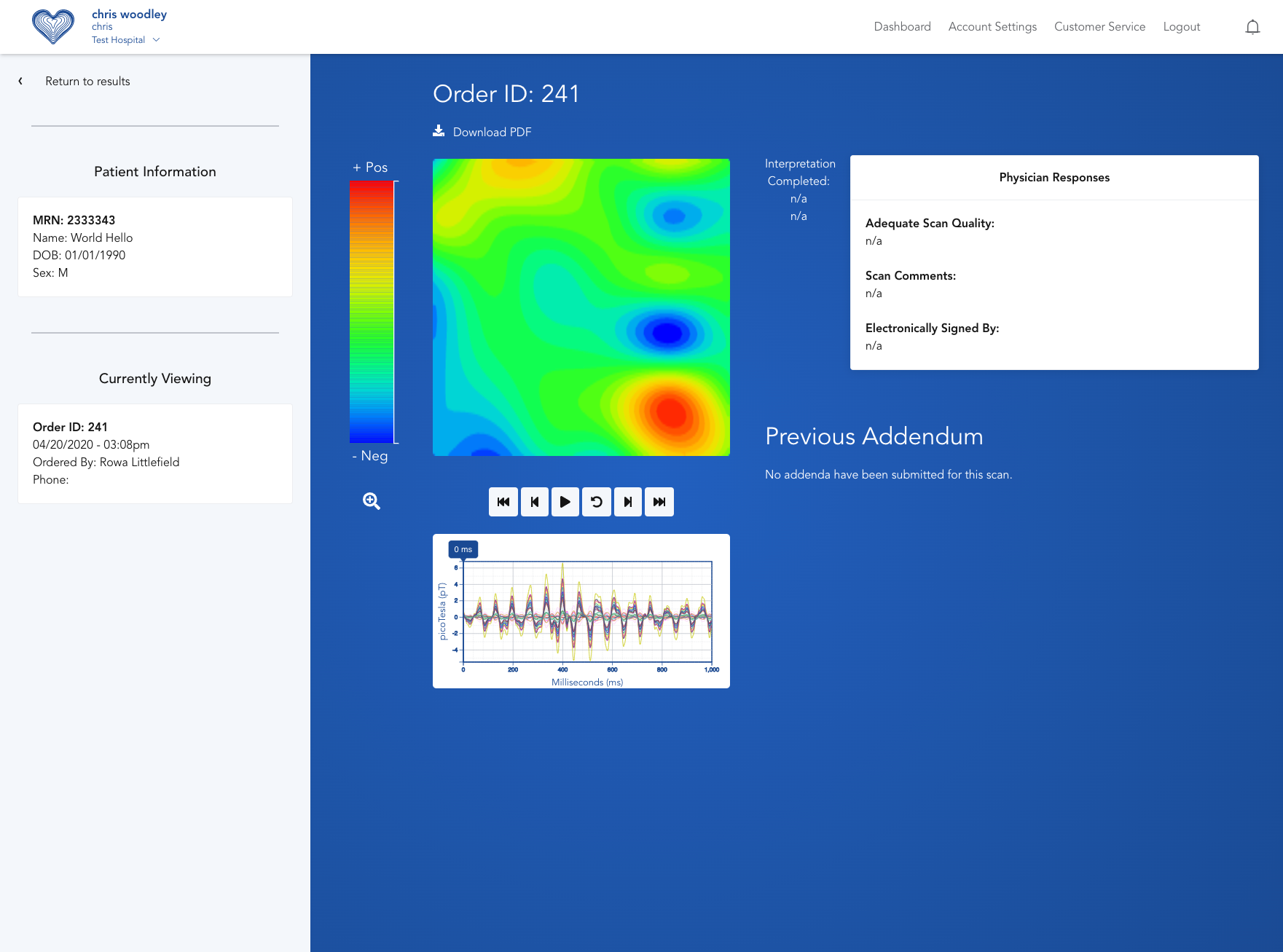
Cardioflux Genetesis Portal exist to help physician’s create Magnetocardiography (MCG) Scan orders that are available for Cardioflux Device Operators. Once the Operator performs the scan the results are sent back to the portal where physicians can review and determine what the best course of action to take with the patient. Physicians receive text notifications when results become available or at specific time intervals set by the physician. The primary goals of this application are:
- Efficiently create and review MCG scans
- Performant and easy to use
- Customize when to receive notifications
- Made for desktop use
Front-end Software Engineer Role
While employed at Genetesis I developed the User Interface (UI) for both Operator software and Cardioflux Genetesis Portal. My role as Front-end Software Engineer:
- Write modular code to create the Site Reader application which helps doctors view and determine the prognosis of Magnetocardiograph (MCG) scans conducted on patients experiencing chest pain.
- Learn how to utilize Electron and Vue.js together to create the Operator application that supports the operation of the CardioFlux MCG medical device.
- Utilize the Vue.js Javascript framework, Storybook.js and SCSS to create a Shared User Interface (UI) library containing re-usable components, directives, mixins, filters, utility functions, and SCSS mixins.
- Create a back-end PDF service to dynamically generate PDF documents using Puppeteer and NodeJS.
- Write Front-end Unit Tests for Vue.js components and Vuex Store Modules using Jest.
- Facilitate creating workflows around Agile Methodologies and SCRUM.
Challenges
- The organization lacked an agile process. My previous experiences with working in an agile environment has allowed me to cultivate the agile process within the organization. The team now does standup meetings every other day, backlog grooming, sprint planning, and sprint reviews.
- The business has multiple applications. Branding and continuity between applications was a concern. I solved this problem by creating a separate shared UI library that included global SCSS mixins and variables, global stylesheet, Vue.js components, mixins, filters, and general utility functions that all applications share.
- Due to deadlines, the team decided to use Element UI component library to help fill in time gaps. If we decide to add style or functional behavior modifications to these components we would not be able to do them directly. I solved this problem by creating “Transparent Wrapper Components” to wrap all of the Element UI components which allowed the team to indirectly add styles and behaviors to the components.
- Initially the applications were created before the Vue CLI was released. The problem is they lacked structure and proper tooling that the Vue CLI provided out of the box. I solve this problem by recreating each application using the Vue CLI. Additionally, I have setup local git hooks to run unit tests and lint the code on pre-push.
- Due to deadlines, the team was not able to write unit tests that should be written along-side the code that was produced. Once the clinical versions of the applications were released, I helped guide the team with a strategy and implementation of writing unit tests.